Showing posts with label pet dental health month. Show all posts

Friday, February 3, 2017

Maxie's Request

Maxwell: Uh, hullo? Miz Tooth Fairy? Are you there?


No offense or anything, but if you don't mind ...


I'd kinda like to keep the rest of my teeth today, if that's okay.

Maxie's at the dentist getting his teeth cleaned today.
Here's hoping he gets to keep that snaggle-tooth.
(and all the rest of them, too!)
***

Wednesday, February 10, 2016

National Toothache Day

In honor of National Toothache Day (which was yesterday, actually) ...

We present to you:
Maxie One-Fang!


(why yes, that is his Mobster Name, how did you know?)

***

Saturday, February 6, 2016

Maxwell Update + Vimtag Winner

Thank you all for your kind words and prayers for Maxie yesterday as he had his annual dental cleaning.

Unlike us humans, a feline dental is usually done under anesthesia, so it's a bit more involved and causes a bit more concern than a human's trip to the dentist!


And this time, it became especially worrisome when we received a call after they had Maxie anesthetized and began to see exactly what they were dealing with.

Maxwell has a condition our veterinarian is convinced was exacerbated by Maxie's poor health as a kitten. Although veterinary medicine has been unable to prove the link between chronic respiratory infections and stomatitis, our doctor has seen far too many to believe it's mere coincidence.

And Maxwell had it all as a kitten: he fought respiratory infections, calicivirus and kennel cough, along with all the ear issues we recently told you about.

Allie: Hrmpf. I had to endure the vet yesterday too, but no one's asking how I fared! I think I'll just leave.

Some day, our boy will be completely toothless. Yesterday, he lost three more. (they wanted to take 4 teeth, but decided to wait and watch the fourth one.)

And two of them were A Big Deal.

The left lower fang (or canine) had severe bone erosion and had abscessed. Despite Marty's persistent attempts to argue for keeping it, eventually he was even convinced it had to come out.

Maxie, this morning. He's on buprenorphine for pain, but otherwise acting like his usual cheerful self.


Taking a lower canine in a feline can be a very challenging thing, and can end with a fractured jaw. Just ask CHo over at Naked and Hungry blog - it happened to her "naked" sphynx cat Jake when the last of his teeth came out.

Our veterinarian, Dr. Eberhardy, told us late yesterday afternoon that Maxie had provided his dental challenge for the month - he said he was sweating bullets during the careful procedure ... but all went well.

The other Big Deal was the big molar in the back. Historically, we've had issues with these incisions getting infected in Faraday and Allie, so we're watching it carefully.

All 3 teeth were on Maxie's lower left side, so he's pretty bare over there now!

How's he feeling? We'll let him tell you himself. ;-)


***
Winner Winner Chicken Dinner!
.

Rafflecopter has spoken, and the winner is:


Concatulations to Sharla, Angel and Isabella over at Beaded Tail!

***

February: Pet Dental Health Month

~ Revised from an original post in 2013

As you may have already heard, February is Pet Dental Health Month.

Did you know that many experts believe dental disease is the number one disease seen by veterinarians? Almost all adult dogs and cats have some form of it.

Inflamed gums around fang & molars from plaque Photo: Marco d'Itri
Over 75% of cats who have their teeth cleaned suffer from tooth resorption and over 80% of dogs over age 5 have periodontal disease. And tartar buildup is common to both.

Why cats are prone to tooth resorption while dogs are more impacted by periodontal disease is a mystery.

Tooth resorption sounds almost like an autoimmune disease: the cat’s own cells attack and wear away at his tooth until it is destroyed. The cause is unknown, though there is some speculation about it.

Faraday: Wait. My toofs are attacking themselves???

Periodontal disease in pets is the same as it is in humans: inflammation around the tooth where the gums pull away and form infected pockets that begin to break down the bone and connective tissue that holds teeth in place.

Needless to say…both are bad for your pet!

There’s this odd phenomenon that occurs when talking about tooth care – and it happens to both humans and pets. People tend to place less importance on dental care than they do basic medical care.

Why is this so? It’s odd, but we tend to forget that our mouth is connected to our body. Most people don’t consider that bacteria thriving in tooth decay can enter the bloodstream and infect critical organs such as the heart, liver or kidneys.

That’s true both for people and for pets.

In older cats especially, oral infections can have a damaging impact on the kidneys. And by the way, renal failure (kidney disease)? It's irreversible. Unlike humans, dialysis is not readily available as a treatment option for failing kidneys, and it's very difficult to administer. And though there have been successful kidney transplants in cats, it's expensive and comes with its own set of complications. Bottom line: help keep your cat's kidneys healthy by keeping his teeth healthy.


Good dental care isn’t that difficult if approached properly, and Dr. Jean Hofve of Little Big Cat has outlined a good five-step plan to get your cat used to daily brushing that works – if you commit to sticking with it. And there are additives you can put in your pet's drinking water that help fight plaque and are Veterinary Oral Health Care approved.


In addition, annual (and depending on the breed, sometimes twice-annual) professional cleaning can work to prevent major dental catastrophes down the line as your pet ages.

Have you ever scheduled a dental cleaning for your pet? Now might be an excellent time to do so, as many veterinarians offer discounts on routine cleaning during February, in honor of Pet Dental Heath Month.

Ours does, and I've taken advantage of that discount for both Faraday and Maxwell (much to their chagrin).

How is your pet's dental health?

Friday, February 6, 2015

Faraday's S.O.S.


(somekitty's getting his teeth cleaned at the vet - right this minute!)

Monday, February 2, 2015

Monday Medical: Pet Dental Health Month

February is Pet Dental Health Month. Did you know that many experts believe dental disease is the number one disease seen by veterinarians? Almost all adult dogs and cats have some form of it.

Wonder how hard it would be to talk Faraday into flossing...?

If you've read my article over on Catster, then you know cats don't get cavities. That's not really a good thing, though. Because what they get instead is something much worse: a disease for which there is no cure, since we simply don't know what causes it. That disease is tooth resorption. You can read more about it here.

"Open wide!" Girl, you're doing it right.

There are a few myths that keep hanging on about dental diseases in our companion animals, and one of them is that it doesn't begin to develop until later in adult years.


Maxwell is living proof that's not true. At 9 months of age, he had his first dental...and lost 12 teeth. Twelve. You can read his story - and more on gingivitis/stomatitis at this link here.

Bottom line: it's never too early to begin good dental hygiene with out pets. And they can never be too young for dental disease to strike.

With aggressive dental treatments at home and at our vet, Maxwell has beaten the odds. They thought he would be toothless by age 5. He'll turn 5 in April.

"Look ma! No cavities!" True, but what about TR? Keep brushing, dood.
We don't know what we'd do without those adorable fangs of yours!

Talk to your vet soon about whether or not your pet should have his teeth cleaned. Many offer discounts during the month of February, in honor of Dental Health Month, so it's a win-win, both for your pocketbook and for your pet!

Monday, February 11, 2013

Straight Talk: a DVM Goes Dental

_______________________________________
Monday Medical Dental Health Series: Part 2
Previous:    2/4/13: Overview
Next week: 2/11/13: Interview with Dr. Huber, part 2
_______________________________________ 


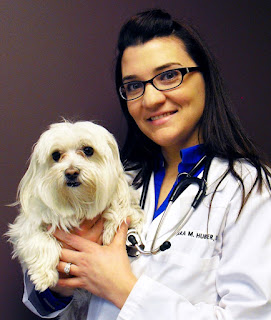
Dr. Huber with one of her patients
Meet Dr. Sara Huber of Leawood Plaza Animal Hospital, the practice that keeps our herd so robustly healthy. This woman is passionate about her charges.

And when we mentioned recently that we had some questions about pets and dental health, it was clear that this is a subject she's also pretty keen on!

A Tonk's Tail: Do you have any pet peeves about the way most pet owners view dental health?

Dr. Huber: Actually, I have two! The first one is the idea that our pets don't really feel or respond to dental pain to the same degree that humans do.

This could not be more false.

Studies performed in the 90's showed that pets react to the same level of stimulation and have the same physiological responses to pain as humans. Cats will instinctively mask pain to avoid predation (a survival tool from their days in the wild), so it may appear as if they are not in pain when they in fact feel quite a bit of discomfort.

If you see a lesion in a pet’s mouth that may cause pain, address it. It is remarkable how many people will say that they notice a tremendous improvement in their pet's attitude and behavior after addressing dental problems.

ATT: You mentioned a second peeve?

DH: Yes. It's when I hear, "he only has mild tartar buildup, its not a big deal."

Tartar build-up (tanakawho, Creative Commons 2.0)
I often hear pet owners state that a pet has terrible breath but only mild tartar buildup so they don't feel a dental procedure is necessary quite yet. The problem is that by the time you begin to see build-up on the tooth, you’re often seeing just the tip of the iceberg.

Teeth that do not appear diseased can have disease under the gum line that goes all the way to the root. This can only be found by a combination of gentle probing deep below the gum line during the oral exam and cleaning process. 

This physical exam, combined with radiographs (x-rays) can reveal disease to the root and even the surrounding bone.

It’s important to remember that tartar builds up because of the presence of bacteria in the mouth. When the gums and/or roots are diseased, this can then allow a direct route for bacteria to access the rest of the body.

ATT: Which leads to the next question: Can dental disease negatively impact overall health?

DH: In a word, YES.

There has been a lot of research done on this particular topic in both human and veterinary medicine. While it has been difficult to demonstrate a direct cause and effect relationship between periodontal health and systemic health, the evidence suggests that this is the case.

Photo: Wikimedia Commons, via Creative Commons 2.0
There have been numerous studies that show an association between oral health and systemic health. If you think about dental disease and what causes it, this makes perfect sense.

Periodontal disease (or disease of the underlying support structures of the tooth) is caused by plaque (bacteria). This plaque becomes mineralized and causes calculus.

As time passes, gingivitis (inflammation of the gums) develops and bacteria gain access to the underlying structures of the tooth. This can cause bone loss and damage to the root.

There are numerous blood vessels associate with the teeth and gums. As dental disease progresses, the bacteria associated with the disease can gain access to the blood vessels and circulate through the system.

Research suggests that this can cause disease in the heart, kidneys, liver, and other body systems. Veterinarians will often give animals an injectable form of antibiotic while under anesthesia for a dental cleaning and send pets home on antibiotics to help prevent the spread of harmful oral pathogens.

ATT: Let’s talk for a minute about older pets and dental health. Are there risks associated with age?

DH: I often have clients that have come from other vets tell me that their vets tell them "my cat is too old for anesthesia and the risks outweigh the benefits of the dental procedure." I then ask them to list the specific risks they’re concerned about and any supporting documentation... and they do not have an answer for me.

I guess you could say I have a third pet peeve:  AGE IS NOT A DISEASE!

While it is true that older animals metabolize anesthesia differently than younger animals, age does not preclude a pet from undergoing anesthetic procedures.

Every pet that goes under anesthesia at our clinic (from infant to geriatric) must have a pre-anesthetic blood panel performed. This will often unmask underlying disease that should be addressed before performing anesthesia.

All pets also have a pre-anesthetic ECG (electrical tracing of the heart) to rule out any problems with heart rate or rhythm that might not be heard on a normal physical exam.

Kitty's Pearly Whites (photo: Klauden, Wikimedia Commons)
We tailor our anesthesia protocols for each particular patient, taking into account age, underlying disease, respiratory compromise, etc.

And while under anesthesia, all animals have a continuous ECG, a pulse oximeter reading (oxygenation of the blood), a respiratory monitor, and a blood pressure taken every 3-5 minutes.

This ensures that we have taken every possible measure to keep each pet safe and healthy while under anesthesia. When a pet is recovering they are monitored by a technician for any distress and a veterinarian is always nearby to address any emergent issues.


DH: This brings me to another fact I’d like to discuss: Senior ailments can actually be compounded by dental issues.

Many senior pets suffer from illnesses such as arthritis, kidney dysfunction, liver disease, cancer, etc. that will affect their appetite and attitude. As I mentioned before, dental disease can often cause significant oral pain and can interfere with an animal’s ability and desire to eat.

Consuming a significant quantity of quality calories and protein is essential for a cat that has a systemic disease. If the cat has oral pain, it is often not willing to eat and this will have a negative effect on their ability to fight disease.

Once dental disease is addressed, the painful stimulus in the mouth is removed and the cat will often show a marked increase in food consumption and improvement in their particular disease.

I cannot prove this as being a direct cause an effect relationship but I have seen many senior cats with severe periodontal disease come in with significantly elevated liver enzymes. After their dental cleaning, these enzymes will often be markedly reduced (if not normal).


Next Week: What questions to ask
your vet before a dental procedure


Monday, February 4, 2013

Monday Medical: Pet Dental Health Month

As you may have already heard, February is Pet Dental Health Month.

Did you know that many experts believe dental disease is the number one disease seen by veterinarians? Almost all adult dogs and cats have some form of it.

Inflamed gums around fang & molars from plaque
Photo: Marco d'Itri via Creative Commons 2.0
Over 75% of cats who have their teeth cleaned suffer from tooth resorption and over 80% of dogs over age 5 have periodontal disease. And tartar buildup is common to both.

Why cats are prone to tooth resorption while dogs are more impacted by periodontal disease is a mystery.

Tooth resorption sounds almost like an autoimmune disease: the cat’s own cells attack and wear away at his tooth until it is destroyed. The cause is unknown.

Periodontal disease in pets is the same as it is in humans: inflammation around the tooth where the gums pull away and form infected pockets that begin to break down the bone and connective tissue that holds teeth in place.

Needless to say…both are bad for your pet!

There’s this odd phenomenon that occurs when talking about tooth care – and it happens to both humans and pets. People tend to place less importance on dental care than they do basic medical care.

Why is this so? It’s odd, but we tend to forget that our mouth is connected to our body. Most people don’t consider that bacteria thriving in tooth decay can enter the bloodstream and infect critical organs such as the heart, liver or kidneys.

That’s true both for people and for pets.

In older cats especially, oral infections can have a damaging impact on the kidneys. And by the way, renal failure (kidney disease)? It's irreversible. Unlike humans, dialysis is not readily available as a treatment option for failing kidneys, and it's very difficult to administer. And though there have been successful kidney transplants in cats, it's expensive and comes with its own set of complications. Bottom line: help keep your cat's kidneys healthy by keeping his teeth healthy.


Good dental care isn’t that difficult if approached properly, and Dr. Jean Hofve of Little Big Cat has outlined a good five-step plan to get your cat used to daily brushing that works – if you commit to sticking with it. And there are additives you can put in your pet's drinking water that help fight plaque and are Veterinary Oral Health Care approved.

In addition, annual (and depending on the breed, sometimes twice-annual) professional cleaning can work to prevent major dental catastrophes down the line as your pet ages.

Have you ever scheduled a dental cleaning for your pet? Now might be an excellent time to do so, as many veterinarians offer discounts on routine cleaning during February, in honor of Pet Dental Heath Month.

Ours does, and Faraday and Maxwell both have appointments this month.


Next week: One DVM goes
dental (that's dental, not mental!)

over your pets and their teeth. 

____________
Sources:

Little Big Cat: Dentistry for Cats
Animal Medical Center: Dentistry
Trupanion Insurance: Breeds that commonly suffer Respiratory Distress
Ped Meds Online: Tonkinese Health Issues
Underlying Causes of Tooth Resorption
National Institutes of Dental and Craniofacial Research: on peridontitis