Showing posts with label pets. Show all posts

Thursday, February 20, 2014

The Moments We Cherish Forever #RecipeForMoments


Maxwell: If you were to ask me about the most special moment momma and I have shared, I’d have to say it was the day I made her cry.

I know, that sounds like crazy talk, right? But let me explain.

It happened the moment I laid eyes on her for the first time.

Actually it happened the moment the rescue worker placed me in her arms and she began to quietly sob.

As I patted gently at the tears rolling down her cheeks, that’s when I knew: momma needed healing.

She feared it was too soon, she said. Her heart wasn't ready for another cat.

But I knew better. And I knew I was just the kitty for the job.

You see a blurry photo from a camera phone, but this moment is crystal clear in my kitten heart.

Those first six months were a lot of work for both of us. Not everyone will adopt a deaf cat, especially one as sick as I was. Twice a day she would medicate me. And twice a day, she sealed each ear with a kiss.

I might not have been able to hear her love, but I sure could feel it.


And I loved her back, with head-butts and nuzzles and loud rumbling purrs.
And that became Our Thing. We were doing FaceTime way before any iphone ever had it!

I’m a strapping three year old now, as healthy as can be. I love playing catch with momma and my Flipper. She's pretty good at kitty games for a human.

"Here, momma! Catch!"

But we still begin each morning with our special moments – our very own FaceTime with head-butts and ear kisses.


I love those times, I do. But the moment that will forever be the most special to me is the day I made her cry.

***


Faraday: Well, I don’t make mommy cry.
I make her laugh.

Rumor has it that I was a needy kitten. Of course we all know that's just a bunch of libel, slander and smack talk.

Needy? Nah. I can't help it that mommy required loads of paw-on training when I first arrived. (She’s coming along quite nicely, by the way.)

And the nickname "ankle-biter" is, of course, nothing more than rumor-mongering and muckraking.

Who knows what lurks under the covers in the middle of the night anyway, I ask you? There are three kitties in this home, and until there is DNA evidence to the contrary, it's Innocent until Proven Guilty, I say!

But I digress.

As I mentioned before, Mommy's coming along nicely. She's become an expert Cuddler, and knows all the best places for scritches.


We do all sorts of stuff together, like read and snuggle. And her opposable thumbs come in real handy when I need my fireplace lit!


I leave it to Maxie to handle the more difficult training, though. Like trying to properly train her to watch BirdTV.


She's hopeless at chittering at birds. She has noooo rhythm. Kinda like Elaine in Seinfeld.
But that's okay. I just bop her one when she does it wrong!


***

 
Allie: Mother and I have more of a working relationship.

I figure it's a nice change of pace for her. I mean, she and Maxie are all mushy, and Faraday, well.... Let's just say The Brat is High Maintenance and leave it at that, shall we?

It’s refreshing to be outside with her, supervising her work. (Well, someone has to do it, and we all know I'm the Responsible cat in the household.)

Of course, it's a lot of hard work for a girlcat like me, but I'm up for it.

Whether it's ensuring she rakes all the leaves into acceptable piles over the fall and winter months, or making sure the catnip in planted in straight, even rows, I'm the girlcat for the job.


I also take Perimeter Sweeps very seriously. Securing the home against all intruders is paramount, and I walk alongside her to ensure everything is properly sniffed and Investigated.


I do enjoy my time with Mother.
However, my special moments are more the father-daughter kind.
Every girlcat needs a daddy to love! (But not mine. He’s already taken.)


And as a feline who’s always fashionable, he also benefits from my sensational sense of style.

Speaking of which:
Oh daddy dear... the 80’s called. They want their sweater back.

 ***

Our story is a part of the #RecipeForMoments blog hop hosted by BlogPaws.

http://blogp.ws/NaturesRecipeScrapbooks


What's your story? 

Link up below to share your story of that special human/animal bond you and your pet share. What do you think your pet feels in your special moments?

Five random U.S. winners who link up their blog post will win a Nature’s Recipe® lightweight collar camera to capture special moments from their pet’s point of view. See BlogPaws for official rules and details.

_____________________

FTC Disclaimer: This post is sponsored by Nature’s Recipe® on behalf of the BlogPaws Blogger Network. I am being compensated for helping spread the word about Nature’s Recipe for Moments on behalf of Nature’s Recipe, but we only share information we feel is relevant to our readers. Nature’s Recipe is not responsible for the content of this article.

Monday, November 12, 2012

Chicken Soup for the Soul

We interrupt Medical Mondays for a special report:

Did you know that today is national Chicken Soup for the Soul Day?


Dr. Marty Becker is a veterinarian who is a regular contributor to vetstreet.com, ABC's "Good Morning America" and the nationally syndicated "Dr. Oz Show."

He's also written several books, including three in the "Chicken Soup" series, specifically about pets.

Our mom interviewed him for Animal Planet a few years ago.

Since Ryker cameos in the interview (um, mom? we think that's called nepotism...?), we thought this would be a fun video to share today.

Plus, what he has to say is pretty cool. Especially that last part about the bed. (SCORE!)


________

Next week's Medical Monday:
Pets, Holiday Travel and Safety


Tuesday, October 2, 2012

LIVE. STRONG.


Cancer has touched the lives of so many we know - human and animal alike.

This day is set aside by Livestrong.org as a day of global, collective action in the fight against cancer.

On this day we want to honor those we know personally who are battling this disease:
from a courageous 8 year old boy...
to a woman who has beat back her own personal "great white shark" for three years (glioma, often called that due to its swift and deadly nature)...
to a beautiful Havanese named Cosmo.

And our own parents, both Marty's and mine, all four of whom have fought or are currently waging their own battles with the "Big C".

 May you all Live Strong.


Monday, May 14, 2012

Monday Medical Issues: Microchips, part 2

Last week, we discussed the risks and benefits of microchipping your pet. This week, we'll look at how the microchip works, as well as other reasons the microchip is worth considering that you might not have thought of.


Science Stuff and
More Myth Busting

A microchip puts out an RF (radio frequency) signal that can be picked up by a scanner. There are 3 different frequencies used by companies that manufacture pet microchips in the U.S.:

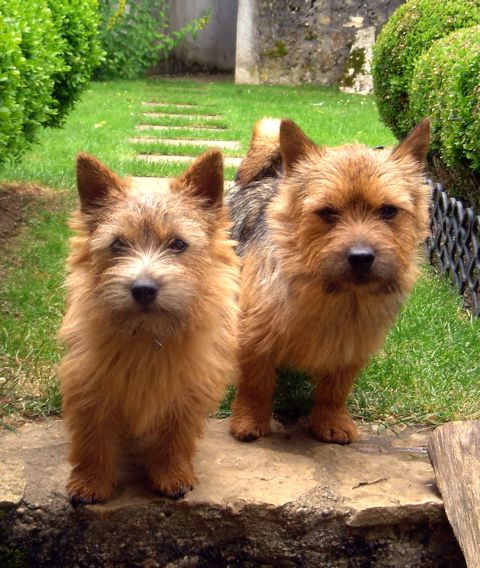
Norwichterrier
Photo Wiki Commons, courtesy Helene Gisin.
Licensed under Creative Commons Share Alike 3.0


125-kHz microchips:
24PetWatch® (unencrypted)
FriendChip®, Avid (encrypted)
HomeAgain®/Digital Angel (unencrypted)

128-kHz microchips:
AKC Companion Animal Recovery®
(AKC CAR®)

134.2-kHz microchips:
Bayer ResQ®
HomeAgain®/Digital Angel


The reason I listed all that geeky kHz stuff above is because there's a myth involved here that we're about to bust. The myth is, "OMG, my cat's got the 134 kHz chip and she's going to get euthanized if she runs away and gets picked up by a shelter that only scans for 125 kHz chips!!"

Not true.

Although individual brands of microchips are designed to work best at their specific frequency, they have quite good readability on other frequencies as well. This is confirmed in FCC government filings which show that scanners marketed as "multi-frequency" are really only single frequency scanners. (see source links at bottom of post)

a kHz sine wave

The second myth to bust is the one about radio frequencies causing cancer. First off, your pet is not walking around broadcasting a signal at all times. in fact, it's the scanner itself that sends out a pulse that "excites" the microchip into giving off a sympathetic response.

(Not that kind of excitement, Cathy Keisha. Just sayin'.)

Second, the signal the scanner provokes the microchip into sending out is orders of magnitude less than that cell phone you hold to your ear on a daily basis. Microchips operate in the kilohertz range; your cell phone emits in the gigahertz range. (And no we're not even getting into the cell phone topic here, LOL!)

Other really good reasons to microchip

Probably the most compelling argument I've ever seen for microchipping your pet occurred this past February -- when I watched the apartment complex where Amy and Kathi lived (Sebastian the Sensitive Soul and CJ's Paw Pad) go up in flames.

As those of you who have followed our blog for some time know, twenty apartments were destroyed in that fire.  A fire that was so bad, the fire inspector told Amy, that "the building was lost before we even arrived."

Police were racing against time to save lives. They were going around kicking doors in. Animals raced out, some never to be found again. One cat, though, was microchipped. His owners were not home at the time of the fire. They lost everything they owned -- except their cat, who was returned to them days later.

In an emergency like a fire or a natural disaster such as the Joplin tornado -- the first anniversary of which we'll be commemorating next week -- your pet can be separated from you in the blink of an eye. A microchip might be the only way they find their way back to you.

Worth it? You bet.

_____________
source:  U.S. FCC database search form

(Submit the form with "Grantee Code" and "Product Code" for each individual scanner; for the new universal Digital Angel/HomeAgain Scanner, still operating at 125 kHz (0.125 megahertz) codes "C5S" and "HS9250L"; for a recent AVID scanner, operating at 134.2 kHz (0.1342 megahertz), codes "IOL" and "-134-AV1034I" .)


Monday, May 7, 2012

Monday Medical Issues: Microchipping

Since May is Microchip Your Pet Month, we thought it would be a good topic for a Monday Medical Issues post.

Microchipping is growing in popularity, with an increasing number of animal shelters offering it as a free service to all animals upon adoption.

But what are the statistics surrounding microchipping?

What are the risks? What are the benefits? And - most important - do the benefits outweigh the risks?

photo: Adobe Veterinary Center
Microchipping your pet involves embedding a rice-sized pellet between your dog or cat's shoulder blades just below the back of the neck. (On other animals the location may vary, and in Continental Europe, the practice is to locate the microchip in the left side of the neck).

No anesthesia is required, though I have to admit, I requested it be done while Faraday was anesthetized during his teeth cleaning after I saw Allie cry out when she was injected - those needles are just a teensy bit bigger than standard!

This pellet contains a tracking number that is maintained in a database. That database contains owner information and, depending on the database, can also contain veterinarian info and even medical records.

When an animal is found, one of the first things a veterinarian or animal shelter does is to scan the animal for a microchip.

Microchip Myths, Facts
and Scientific Stuff


One of the stories circulating around microchips is that they cause cancer. That fear may be related to the fact that some vaccination injection sites have proven to cause cancer in some animals, particularly cats. (this will be the topic of a future Monday Medical Issues post). Here's what the research tells us: the British Small Animal Veterinary Association (BSAVA) maintains a database on the adverse reactions of microchips on animals. At the time the study was posted, only 391 animals out of 4 million were reported experiencing an adverse reaction. That's 0.00010%, or 1 out of every 10,000 animals microchipped.

And the majority of those issues involved the migration of the microchip, not cancer. Two of those cases recorded were dogs who had developed cancer at the site, but one of them, according to the BSAVA study, may have been caused by something else.

In comparison, you're about 4 times more likely to die in an auto accident than your pet is to have any kind of adverse reaction at all, and 4 times more likely to be struck by lightning than your pet is to get cancer from a microchip.

As a result, the American Veterinary Medical Association has deemed microchipping to be worth the risk. 


Picture Source: ainhoap and Animal Photos!
Why? Let's talk about the benefits for a few minutes. 

A study of almost 8,000 stray animals at animal shelters concluded that dogs who were not microchipped were only reunited with their owners about 22% of the time.

Dogs who were microchipped were reunited over 52% of the time. 


That more than doubled your pup's chance of finding you should you become separated. 

And the odds for cats exponentially increase. A non-chipped cat has less than a 2% chance of being reunited with his owner. But microchipped cats went back to their families almost 40% of the time.

We're all for increasing the odds of any lost pet being rehomed, so we give microchips four paws up.


Next week:  

The science behind how microchips work 
and other reasons for microchipping you 
might not have considered


_____________
sources:  Lord, et al, "Journal of American Veterinary Medicine Association", July 15, 2009 


Monday, April 30, 2012

Monday Medical issues: Antifreeze


Yesterday I went outside to find my husband tackling a radiator. Jury’s out on who won that round – him or the radiator – but in the act of replacing it, copious amounts of antifreeze were unloaded into a big round pan.

And I’d just let Allie out to help me dig holes in the garden! EEK!

I scooped that pan up so fast (okay, not so fast that any of it sloshed out!) and stuck it high up on a shelf where no cat or dog could access it.

The reason for my panic is that antifreeze is deadly to pets. If a cat were to simply walk through it and lick the antifreeze off its paws – that’s enough to kill. And a mere 5 tablespoons of the stuff is fatal to a medium sized dog.

Sadly, both dogs and cats – and children, too! – appear to be drawn to antifreeze. I’m not sure what makes it seem so tasty to them, but if allowed, they’ll drink it.

Antifreeze contains Ethylene (or Diethylene) Glycol, which breaks down into toxic substances once processed through the liver. These toxic substances will then cause kidney failure if not treated immediately – or faster than that! – since absorption can occur so quickly.

Once Ethylene Glycol is ingested, it is rapidly absorbed into the liver from the intestines, and you can begin to see symptoms as soon as 30 minutes after your pet has been exposed. If you suspect your dog or cat has ingested antifreeze, urgently seek emergency help.

If caught quickly enough a vet can administer a drug that temporarily suspends liver function, allowing the antifreeze to pass through the system without breaking down into its toxic components.

They will most probably induce vomiting to expel any remaining antifreeze in the stomach before it hits the intestines, as well as feeding your pet charcoal to bind to any remaining antifreeze.

The charcoal will prevent the intestines from absorbing the antifreeze and sending it on to the liver.

The odds that all antifreeze will be caught before metabolizing are very slim, though, but an emergency vet can also place your pet on dialysis to flush the kidneys and help mitigate the damaging effects of the antifreeze. Hopefully with swift action, the kidneys will be hit with a small enough amount of poison and they will be able to repair themselves.

The best thing you can do, though, is to practice prevention.

Please don’t underestimate the extreme hazard of this substance – to dogs, cats and children. Keep such harmful toxins stored safely out of reach – and if spills occur, immediately saturate the surface with water to dilute and disperse.