Four times a year, pet bloggers band together to raise awareness
about issues critical to the welfare of the animals we love.
Issues like this one.
________________________
This special Monday Medical post is about the worrisome increase in pet food recalls over the past year.
 |
| One of the brands identified by FDA |
As of May, 2012, the FDA had received nearly 1,000 reports of illnesses and/or deaths of dogs who had consumed chicken jerky treats made in China.
As of July, 2012, 47 people in 20 U.S. states (plus 2 in Canada) had suffered salmonella poisoning traced back to the handling of dry pet food made in the USA.
I’ve been sitting back and reading about the vast number of pet food and pet treat recalls over the past year, but haven’t really done anything to address it on this blog, mainly because of the vast amount of exposure it's had on other blogs. I didn't feel I could add much to the conversation until now.
But a few weeks ago some information was dropped into my lap by a radiation physicist.
Here’s what I was told.
The FDA imposes a limit on the amount of radiation human-grade food items may be given. It also imposes a limit on the amount of radiation given to animal feed – and pet food comes under those guidelines.
In general, the FDA allows a much lower dose of radiation to kill harmful bacteria on human grade food than it does for pet food.
 |
| Raw eggs: allowed 5 kGy to protect from salmonella |
For example, raw fruits and vegetables are allowed a maximum of 1 kiloGray of radiation to kill bacteria, but the amount increases five-fold for raw eggs. Given that eggs pose a salmonella risk, that’s understandable.
Frozen raw meat is allowed a bit more than eggs - 7 kGy. And again, given that there are
between6 and 33 million illnesses a year in the U.S. alone1 due to microbial pathogens found in raw meats, that completely makes
sense.
Yet pet food is allowed 50 kiloGray. That's
ten times the FDA limit for raw eggs.
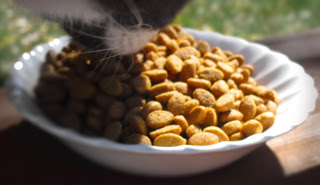 |
| Pet food: allowed 50 kGy to kill pathogens |
If you read any label, you’ll see pet food ingredients come from the
same sources as ours: meats, grains, vegetables, fruits.
So why would pet food be allowed ten times the radiation as raw eggs and
fifty times the radiation for raw vegetables?
These are significantly
higher levels.
The answer simply is that food is split into two categories: human
grade food, and food not fit for human consumption.
The husband of an associate of mine grew up on a ranch in the Midwest
U.S., and he tells a story about where their sickly and deceased animals
were sent. You guessed it: the pet food plant. He said there would
often be days that passed between the time they notified the pet food
plant about the dead animal’s carcass and the time workers at the plant
arrived to pick it up. During that time, the carcass remained exposed to
the elements. That could mean high temperatures, insects – plenty of
opportunity for decay and bacteria growth.

Fifty kiloGray. One can understand the need for a higher amount of
radiation after hearing the rancher’s tale.
But given the rash of
recalls in 2012 alone, even that doesn’t seem to be working so well,
does it?
To be fair, yes, animals can handle eating things we can’t, but a cat
killing a mouse and then eating it, bones and all – well, that’s a fresh
kill. There's little chance for bacteria to become an issue.
After reading all this, I was very glad for the decisions I’d made
regarding what our cats eat. Of the three brands of cat food served in our home, one uses human
grade ingredients and another requires that its farmers and suppliers
provide Letters of Guaranty stating that their meats and produce are
fresh and unadulterated. The third brand has very strict protocols in place
and rigorously tests for salmonella and E. coli (though to be honest, I
am trying to wean a certain kitty – yes, Maxwell, I’m looking at you! –
off this third one).
I understand that price can prohibit some from switching over like I
have. I only have the three cats, but I know several people who rescue and/or
foster animals for whom the premium pet food might be too expensive.
But I have to admit, I was intrigued to see
the post by Whisppy showing
how they make their own dried chicken jerky treats right in their
home. So I did a little research on what it might take to make pet food – and how that might impact our budget. That’s fodder for
another post (ouch, kind of a bad pun there, wasn't it?). But I can tell
you that when we ran the numbers, the cost of homemade pet food looked pretty promising.
Please…tell us what you think on this issue. Are you concerned about the
quality of pet foods in the U.S. and do you think the number of recalls
this year is cause for alarm?
_______
Footnote:
You’ll notice in the table below that there are two
human-grade food items that exceed the 5-7 kGy limit, and those are spices
and astronaut food. We figure NASA’s got a lot of special reasons for
wanting their food to be especially sterile, so we’re counting that out
of this discussion.
But we find it interesting that the FDA allows 30 kGy for spices, due to
the extremely high incidence of molds and other bacteria found in them –
especially those coming from countries known to have a higher level of
contaminants.
In fact, spices are so easily contaminated that doctors will tell
patients who are undergoing stem cell transplants to avoid all spices
before, during and for a period after treatment, to protect them while
their immune systems are weakened.
_______
Sources:
http://www.fda.gov/food/foodingredientspackaging/irradiatedfoodpackaging/ucm081399.htm
Table 6.2. Foods Permitted to be Irradiated Under FDA's Regulations (21 CFR 179.26).
Food
|
Purpose
|
Dose
|
Fresh, non-heated processed pork
|
Control of Trichinella spiralis
|
0.3 kGy min. to 1 kGy max.
|
Fresh foods
|
Growth and maturation inhibition
|
1 kGy max.
|
Foods
|
Arthropod disinfection
|
1 kGy max.
|
Dry or dehydrated spices/seasonings
|
Microbial disinfection
|
30 kGy max.
|
Fresh or frozen, uncooked poultry
products
|
Pathogen control
|
3 kGy max.
|
Frozen
packaged meats (solely NASA)
|
Sterilization
|
44
kGy min.
|
Refrigerated, uncooked meat products
|
Pathogen control
|
4.5 kGy max.
|
Frozen uncooked meat products
|
Pathogen control
|
7 kGy max.
|
Fresh shell eggs
|
Control of Salmonella
|
3.0 kGy max.
|
Fresh or frozen molluscan shellfish1
|
Control of Vibrio species
and other foodborne pathogens
|
5.5 kGy max.
|
http://www.fda.gov/food/foodingredientspackaging/irradiatedfoodpackaging/ucm081399.htm
Food for irradiation
|
Limitations
|
Use
|
Bagged complete diets,
packaged feeds, feed ingredients, bulk feeds, animal treats and chews
|
Absorbed dose: Not to
exceed 50 kiloGrays. Feeds and feed ingredients treated by irradiation should
be formulated to account for nutritional loss.
|
Microbial
disinfection, control or elimination
|
http://www.accessdata.fda.gov/scripts/cdrh/cfdocs/cfcfr/CFRSearch.cfm?fr=579.22
http://www.ncbi.nlm.nih.gov/pubmed/7483863
1
Ahn, D. U., Jo, C., Olson, D.G. “Analysis of volatile components and the sensory
characteristics of irradiated raw pork.”p. 209-215.


 All opinions stated in these tweets are strictly my own. They do not reflect the views of my typist. (*sigh* Mother made me post this.)


